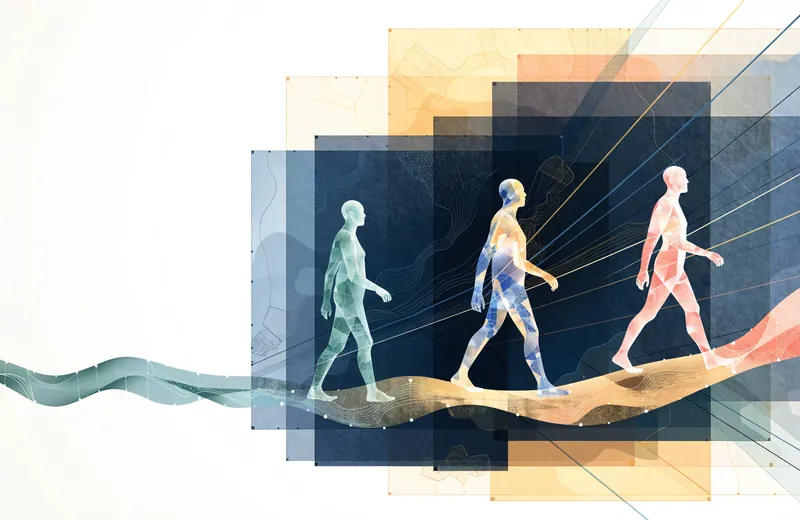
A team is a blend, not an average
Put people with different styles together and something new shows up — a character that belongs to the whole group and to no single person. A team of fast deciders moves at a thrilling pace, though it may skip a detail or two. A team of careful analyzers produces beautiful work, though it can get stuck polishing it. Bring both into one room and you have real power waiting to happen, as long as they understand each other. That is the hopeful part: the blend, not any one person, decides how far you go — and a blend can be understood and steered.
How styles complement each other
The best thing about a mixed team is that each style quietly protects the others. Strong teams combine styles that cover the blind spots no one can spot alone:
- Planners bring the structure that keeps doers from charging off in the wrong direction.
- Doers bring the momentum that keeps thinkers from analyzing forever.
- Thinkers bring the depth that keeps planners and doers from missing what truly matters.
- Collaborators bring the glue that keeps everyone aligned, talking, and rowing together.
When all four are humming, the group is genuinely hard to beat, because one style's weakness is exactly another's strength. What holds a team back is sameness: a room of only doers ships fast and breaks things, and a room of only analyzers never quite ships at all. Difference, it turns out, is the gift — and it is why healthy teams spread the work across complementary team roles rather than stacking the same strength over and over.
How styles clash
Here is the reassuring twist: the very differences that make your team strong are the same ones that spark its friction. Once you see that, the friction stops feeling like a threat. The usual collisions:
- Fast deciders vs. careful analyzers. One senses the other is reckless; the other senses they are stalled. Both are trying, in their own way, to protect the work.
- Direct communicators vs. steady ones. Bluntness can read as rudeness; tact can read as dodging. Neither is meant that way.
- Structure lovers vs. improvisers. One wants the plan locked and safe; the other wants room to adapt as things change.
None of these is a character flaw. They are the predictable result of styles meeting — which is wonderful news, because predictable things become manageable the moment you name them.
Why naming the mix lowers friction
The most powerful move a team can make is also the simplest: name your mix out loud. When a careful analyst and a fast decider both realize they are only running different styles, "you're too slow" and "you're too reckless" quietly become "we balance each other, so let's plan for it." The tension stops being personal and turns into a shared design question: how do we keep the analyst's rigor *and* the decider's speed? Working in a team gets noticeably lighter once people trade blame for that kind of question.
Teams that map their styles argue far less about *how* — and pour that energy into the far more interesting question of *what*.
Putting it to work
Here is a simple, doable way to start — nothing dramatic, just a few small moves that shift the whole dynamic:
- Each person names their own style — planner, doer, thinker, collaborator — and the traits underneath it.
- The team maps the mix. Where do we double up? Where is a style quietly missing?
- Name the likely friction points before they flare, and agree on how you'll meet them — for example, "we give analysts a clear deadline, and we ask deciders to pause for one check."
- Use the gaps to shape team roles and hiring, so the group rounds itself out instead of cloning the strength it already has.
The best first step is knowing your own style, because a team map is only as clear as the people on it. A free self-analysis test shows you the traits — structure, decisiveness, communication, warmth — that shape exactly how you show up when you are working in a team.
Your team can grow far stronger
A team personality is the mix of its people, and that mix becomes a real strength the moment it is understood — it only stays a source of friction while it stays hidden. So map the styles, celebrate the complements, name the clashes kindly, and build straight across the differences. That is how a group of individuals grows into a team that covers its own blind spots and pulls in one direction. Start by understanding your own style with the free self-analysis test, or see how style maps to roles on the career personality test page.
For more context, read the methodology behind this self-analysis approach, the educational-use disclaimer, or explore more guides in career & work.
Start the free self-analysis test